







A steel box may look heavy enough to stay put forever. But in a real tornado, weight alone is not safety. If a shipping container is left unsecured, poor site planning can turn a useful unit into a dangerous problem. The right answer is smart anchoring, reinforcement, and engineering.
Yes, a tornado can pick up or move a 40 foot shipping container, especially if it is an empty container or not properly anchored. A standard 40-foot steel container weighs about 8,157 lb empty, but tornadoes can produce EF3 to EF5 winds from 136 mph to over 200 mph, and the National Weather Service warns that tornadoes can hurl objects like deadly missiles. Proper anchoring and reinforcement can greatly improve performance, but a standard container is not automatically tornado-proof or a FEMA safe room.
Outline
Can a shipping container really be moved by a tornado?
How much does a 40-foot shipping container weigh, and why does that still not guarantee safety?
What tornado wind speeds are strong enough to displace a container?
Can a shipping container withstand high wind or hurricane conditions better than tornado conditions?
Why is proper anchoring more important than container weight alone?
What are the best ways to anchor a container to the ground?
Can a container home survive a tornado if it is reinforced?
Is a shipping container tornado-proof or safe as a storm shelter?
What site conditions matter most for on-site container safety?
How should B2B buyers plan container projects in tornado-prone regions?
Can a shipping container really be moved by a tornado?
Yes. A tornado can move a shipping container. The National Weather Service says tornadoes are capable of completely destroying well-made structures and hurling objects through the air like deadly missiles. That means even a heavy steel unit can be dislodged, tipped, rolled, or thrown if it is unsecured or poorly installed.
This is the point many buyers miss. A container looks massive, but wind does not need to lift it straight up like a crane. A tornado can create uplift, lateral force, twisting action, and pressure changes at the same time. Once the container starts to slide, tip, or rotate, the risk grows quickly. In real extreme weather, the container can become one of the objects the storm uses to damage everything around it. That is why an unanchored box can effectively become deadly missiles in a severe event.
So the honest answer to the title question is simple: yes, a tornado can pick up or at least violently displace a 40-foot unit. The more useful business question is not “Can it happen?” It is “How do we reduce that risk on a real project site?” That is where anchoring, foundation design, and engineering matter most.
How much does a 40-foot shipping container weigh, and why does that still not guarantee safety?
A standard 40-foot steel shipping container has a tare weight of about 8,157 lb or 3,700 kg, according to Maersk’s dry equipment specifications. CMA CGM lists a very similar average tare of about 3,720 kg for a 40′ standard unit. That is heavy, but it is still only the starting point for storm safety.
Weight helps, but weight alone does not guarantee a container can withstand a tornado. A tornado does not apply force in one clean direction. It can hit from changing angles, create suction effects, and push on a large steel surface. A 40-foot box also presents a broad side to the wind, and that creates strong overturning and sliding loads. In practice, an empty container is much more vulnerable than a loaded one, but both require proper anchoring if the site expects strong winds.
This is why I never advise buyers to rely on mass alone. “The container weighs several tons” sounds reassuring, but it is not a design method. In tornado-prone regions, project safety depends on whether the unit is secured to the ground, how the base is designed, and how the full system handles wind exposure.
What tornado wind speeds are strong enough to displace a container?
The National Weather Service’s Enhanced Fujita scale rates tornadoes from EF0 to EF5 using estimated three-second gusts. The scale lists EF0 at 65–85 mph, EF1 at 86–110 mph, EF2 at 111–135 mph, EF3 at 136–165 mph, EF4 at 166–200 mph, and EF5 at over 200 mph.
That matters because once you move into higher categories, you are no longer dealing with ordinary storm conditions. A strong tornado wind event can easily exceed the forces that many casual site setups were never engineered for. If a project team assumes that “steel equals safe,” they may overlook the difference between a container that can handle routine weather and one that can withstand a tornado.
A useful planning threshold is not to assume a container is fine just because it survives 130 mph or even 180 mph vendor marketing claims. Tornadoes are more chaotic than steady design winds, and the NWS makes clear that the most violent tornadoes can go beyond 200 mph. That is why a real tornado design conversation must be more conservative than a simple “mph winds” brochure claim.
Can a shipping container withstand high wind or hurricane conditions better than tornado conditions?
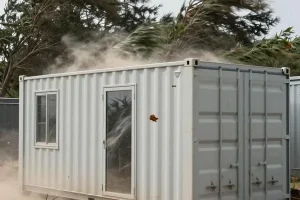
In general, a shipping container can often handle high wind or hurricane exposure better than direct tornado impact, especially when it is engineered and anchored correctly. That is because hurricanes usually impose broader, longer-duration wind loading, while tornadoes add more concentrated rotation, debris impact, abrupt pressure changes, and highly localized peak forces. FEMA and the NWS treat tornado-safe design differently from general storm design for that reason.
This distinction is important for container projects. A container may perform reasonably well in severe weather and even withstand high winds when it is tied down to a proper foundation. But that does not mean the same unit will safely survive a tornado without special design. FEMA safe room criteria are meant for near-absolute protection from extreme wind and wind-borne debris, which is a much higher life-safety standard than ordinary building use.
So when buyers compare hurricane and tornado risk, they should not treat them as the same engineering problem. A container that performs well in hurricane-grade wind may still fail under direct tornado loading, especially if the site also faces flying debris and impact from other loose objects.
Why is proper anchoring more important than container weight alone?
Because storm safety depends on the whole load path. A heavy box that is not tied into the ground is still just a heavy loose object. Proper anchoring is what transfers uplift, overturning, and sliding loads from the container into the soil or structure below. Without that connection, the container can move long before the steel shell itself fails.
This is also why ordinary site placement is not enough. Simply setting a shipping container on blocks, loose pads, or an unengineered slab does not make it storm-resistant. The design should consider the corner castings, connection hardware, foundation type, soil condition, and expected wind speeds. The ICC’s guideline for repurposed ISO containers exists precisely because repurposed containers as buildings need proper design, review, and approval rather than informal assumptions.
In practice, proper anchoring and reinforcement do more than help the container stay down. They also protect adjacent buildings, workers, and nearby infrastructure. For project owners, that turns anchoring from a small installation detail into a major life-safety and liability issue.
What are the best ways to anchor a container to the ground?
The best method depends on soil, site use, transport needs, and local engineering rules, but common options include fixing the container to concrete footings, a full concrete foundation, a concrete slab, or a prepared concrete pad using connections through the corner castings. In container practice, twist locks, twist-locks, bolt connections, and in some cases weld connections are typical ways to tie the unit into the base or support frame. The standard corner fitting geometry defined by ISO 1161 is what allows container locking hardware to work with the corner castings.
For temporary or semi-permanent sites, ground anchors or helical anchors are also common, especially where a poured foundation is not the preferred route. Some industry guides describe aligning anchors with the corner castings and using high-tension connectors, brackets, or cable restraints to help resist uplift. These are practical field methods, but the final design still needs local engineering review.
The most important rule is this: do not just secure the container in one way and assume the job is done. The full system should account for overturning, sliding, uplift, corrosion, and maintenance access. If you are planning to fasten a container to the ground, engineering the foundation and connector system together is far safer than adding anchors after the unit is already on-site.
Can a container home survive a tornado if it is reinforced?
A container home can perform better if it is anchored and modified well, but that does not automatically make it safe against every tornado. Reinforcement may include strengthening openings, adding steel plates, improving the roof and wall structural behavior, stiffening modified areas, and tying the structure into a foundation designed for site loads. Those steps can help the unit better handle extreme conditions.
But there is a big warning here. Cutting large windows, doors, or multi-unit openings into a cargo container is a modification that changes the original load path. Once that happens, the box is no longer behaving like an untouched cargo unit. That is one reason ICC published specific guidance for the safe use of ISO containers repurposed as buildings and building components.
So yes, a reinforced unit may be more likely to survive a tornado than an unanchored box, especially against weaker events like some EF2 or lower exposures at the edge of a storm path. But if the question is whether any standard modified container can automatically withstand a tornado, the answer is no. Reinforcement helps, but it is not a substitute for full wind engineering and debris-impact design.
Is a shipping container tornado-proof or safe as a storm shelter?
A standard shipping container is not automatically tornado-proof. FEMA says only specially designed and constructed safe rooms built above minimum code requirements offer near-absolute protection during a tornado or hurricane. FEMA’s residential safe room guidance also cites a storm-shelter design wind speed of 250 mph for residential safe rooms, and the agency emphasizes protection from wind-borne debris.
That is a very different standard from simply using a steel cargo box. A container can be part of a storm-shelter project if it is specially engineered, reinforced, anchored, and tested to the right criteria. But a normal cargo unit, even a strong one, should not be marketed or used as a life-safety shelter just because it is steel. The distinction between “strong storage box” and “FEMA/ICC-compliant safe room” matters.
For project clients, this means one clear rule: do not tell workers or families to use a standard container home or site office as a tornado refuge unless it has been designed for that purpose. If you need life-safety refuge, design and certify a proper safe room. If you need secure storage or project housing, design the container for wind loads but keep shelter claims separate.
What site conditions matter most for on-site container safety?
The container itself is only part of the answer. Site grading, drainage, soil type, exposure, foundation layout, and surrounding obstructions all affect wind behavior and structural performance. A strong container placed on a weak base can fail as a system. A good site layout reduces water problems, keeps the base stable, and improves the long-term structural integrity of the installation.
Project teams should also think about what is around the unit. In a tornado, loose tools, roofing sheets, timber, sign panels, and other objects can penetrate walls, windows, or openings. Even if the box itself stays in place, nearby debris can still demolish cladding, doors, and utilities. The NWS explicitly warns that tornadoes hurl objects like deadly missiles.
That is why real on-site planning matters. A secure container installation needs the right base, the right orientation, the right anchor design, and a clean site with fewer loose hazards. A steel shell helps, but project resilience comes from the whole installation strategy.
How should B2B buyers plan container projects in tornado-prone regions?
For contractors, EPC firms, government buyers, NGOs, mining operators, and prefab building distributors, the first step is to define the use case honestly. Are you planning storage solutions, workforce accommodation, a temporary office, or a true storm refuge? Those are not the same problem, and they should not be designed the same way. Your uploaded brief makes clear that your factory serves exactly these global B2B project clients with customized modular housing solutions.
The second step is to choose a modular format that matches the deployment logic and site risk. For fast project rollout, a folding container house for rapid deployment can be efficient. For repeated-use engineering camps, a detachable container house for project reuse may be smarter. For scalable camp delivery, a flat pack house for camps and site offices can improve logistics. And where interior space matters, an expandable container house solution can offer a better footprint after deployment. These are all live pages on Sinomega’s current site.
The third step is to combine the product choice with engineering. Sinomega’s homepage says the company specializes in integrated design, manufacturing, and global delivery of modular housing units and highlights certified welding and materials, an in-house R&D team, and export experience in 60+ countries. For buyers who need both modular speed and site-specific project support, that kind of factory profile matters. You can also guide readers toward the broader modular housing factory overview and the educational blog piece on folding container house and modular housing solutions for global projects.
Practical risk table: what changes the outcome?
| Factor | Lower-risk setup | Higher-risk setup |
|---|---|---|
| Container condition | Loaded or engineered installation | Empty container set loose |
| Base | Engineered concrete footings or foundation | Blocks, loose pad, or no designed base |
| Connection | Proper anchoring, bolts, twist-lock connectors, or welded frame tie-ins | No fixed connection to ground |
| Use | Site office or housing designed for wind loads | Assumed storm shelter without engineering |
| Surroundings | Clean site with fewer loose objects | Debris-heavy yard with unsecured materials |
| Storm type | General high-wind or hurricane exposure | Direct tornado strike with debris |
The point of this table is simple: the same shipping container can behave very differently depending on several factors. Weight matters, but the outcome is controlled more by anchoring, base design, debris risk, and storm severity.
FAQs
Can a tornado pick up a 40 foot shipping container?
Yes. A tornado can move, tip, roll, or pick up a 40-foot shipping container, especially if it is empty or unsecured. A standard 40-foot steel container weighs about 8,157 lb empty, but tornadoes can exceed 200 mph and can hurl objects like deadly missiles.
Can a shipping container withstand a tornado?
A standard cargo container should not be assumed to withstand a tornado just because it is steel. It may perform better than lighter structures, but tornado survival depends on anchoring, foundation design, modifications, debris impact, and storm intensity. Only specially designed safe rooms provide near-absolute protection.
Is a shipping container tornado-proof?
No. A normal shipping container is not automatically tornado-proof. FEMA says only specially designed and constructed safe rooms built to the right criteria provide near-absolute protection from extreme winds and debris.
How do you secure a container to the ground for high wind?
Common methods include connecting the corner castings to a steel or concrete base using bolts, welded assemblies, or twist locks, and in some projects using ground anchors or helical anchors. The exact method should be engineered for local soil and design loads.
Is a container better in a hurricane than in a tornado?
Often, yes. A well-anchored container may handle some hurricane conditions better than a direct tornado strike because tornadoes create more concentrated wind rotation and dangerous debris impacts. But neither condition should be treated casually.
Can a container home be used as a storm shelter?
Not by default. A container home or site office should not be treated as a storm shelter unless it has been specially engineered and built to the correct safe room standards.
Key things to remember
A tornado can move a 40-foot shipping container, especially if it is not anchored.
A standard 40-foot steel container weighs about 8,157 lb empty, but mass alone is not enough.
EF3 to EF5 tornadoes range from 136 mph to over 200 mph.
Proper anchoring is more important than simply assuming the unit is heavy enough.
Common securement methods include engineered foundations, anchors, and connections through the corner castings.
A standard container is not automatically a FEMA-compliant tornado shelter.
For B2B projects, the safest path is to combine the right modular product with site-specific engineering, anchoring, and deployment planning.
If you want, I can continue with the next article in this same style and keep the Sinomega internal links natural and non-repetitive.