







Author: Sinomega House Technical Team | Published: September 22, 2026 | Information basis: current Sinomega website statements and buyer verification practice
Choosing a container house factory is a verification task, not a search for the lowest catalogue price. Overseas distributors and EPC teams should check the manufacturer's product drawings, material scope, production responsibility, packing method, export documents, customization process and after-sales boundaries before comparing offers.

What Sinomega states about its factory capability
Sinomega House (Qingdao) Co., Ltd. describes itself as a manufacturer and exporter of modular container houses and prefabricated building units. Its website states that it has a 10,000 m2 factory near Qingdao Port, more than 10 years of prefabricated-construction experience, in-house steel fabrication, wall-panel production and system assembly, and OEM/ODM branding support.
These are website-stated company claims. They are useful starting points for an RFQ, but they are not an independent factory audit, current capacity certificate or destination-code approval. A buyer should ask for dated, project-specific evidence before relying on any claim in a contract.
The Sinomega About Us page provides company context. Use it to prepare questions, then request the documents and drawings that answer those questions.
Start with the product and drawing scope
A credible factory should be able to identify the exact product family and drawing revision behind a quotation. Sinomega's product directory includes Folding Container House, Detachable Container House, Flat Pack House and Expandable Container House systems.
| Verification item | What to request from the factory | Why it matters |
|---|---|---|
| Product family | Named model and product-page reference | Prevents a generic price from hiding a different system |
| Drawing revision | General arrangement, floor plan, elevations and revision date | Gives procurement and engineering teams one reference set |
| Dimensions | Closed, assembled and expanded dimensions where applicable | Controls transport, foundations, clearances and room planning |
| Material scope | Steel sections, coatings, panels, roof, floor, doors and windows | Makes supplier quotations comparable |
| Options | Bathroom, kitchen, electrical, furniture, HVAC and branding | Separates standard supply from optional packages |
| Exclusions | Buyer-supplied works, local installation and approvals | Prevents missing costs at the destination |
For example, the folding product page lists a standard size of 2438 x 5800 x 2520 mm, listed occupancy of 1-2 people and listed power of 12 kW. The detachable and flat-pack pages list different dimensions and configurations. Do not transfer a figure from one product family to another.
Verify the factory's actual production responsibility
Ask which operations are performed in-house and which are subcontracted. Sinomega's website describes in-house steel fabrication, wall-panel production and system assembly. A useful audit request maps each stage to a location and inspection record:
- steel cutting, welding and corrosion protection;
- panel production or panel sourcing;
- floor, roof, door and window assembly;
- electrical and sanitary pre-installation;
- dimensional inspection and trial assembly;
- packing, marking and container loading.
In-house production may simplify coordination, but it does not prove that every component is made on the same site. Request a process flow, responsible department and inspection point for each item in the bill of materials.
Check quality control against the order, not a brochure
Quality control should be tied to measurable requirements in the approved drawings and purchase order. A buyer can ask the container house factory for a quality plan covering incoming materials, welding, coating, panel installation, dimensions, door and window operation, utilities and final packing.
The inspection file should identify the inspector, date, sample or unit number, acceptance criteria, nonconformity action and release decision. If a test or certificate is not available for the selected product, leave it out of the contract rather than assuming that a different model's document applies.
The website refers to fire-resistant insulation panels. That description does not replace a product-specific fire classification or destination-code review. Likewise, do not describe a building as fireproof, earthquake-proof, waterproof or code-compliant without the applicable documents.
Inspect packing and export readiness
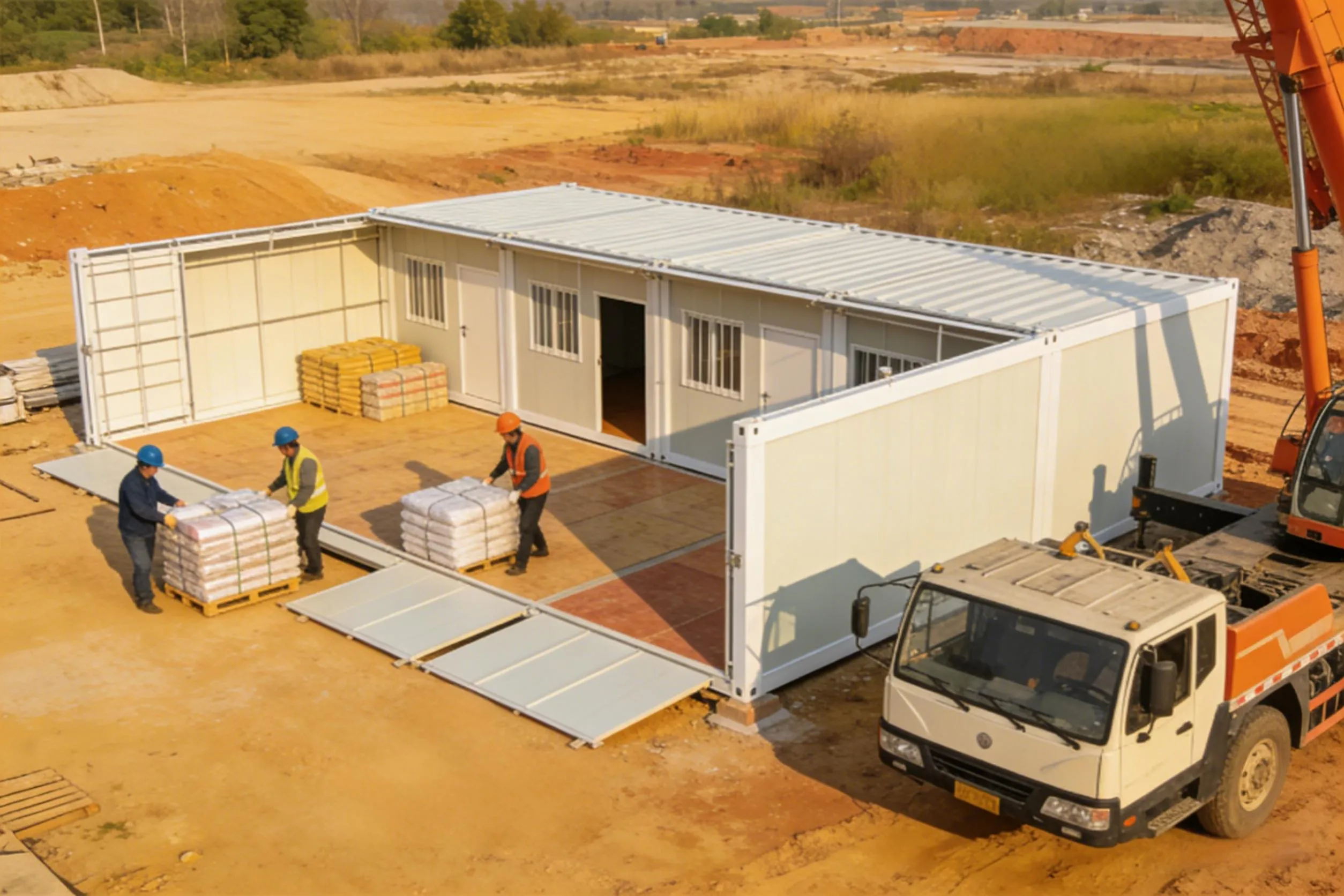
Packing is part of the product scope for an overseas project. Ask for a packing list, loading diagram, gross and net weights, package dimensions, lifting points, protection method, marks and container utilisation plan.
The product pages make transport-efficiency claims for folding and expandable systems. Treat each claim as model-specific until the factory confirms the selected configuration. Shipping-line and customs requirements should be checked for the destination route; a factory brochure is not a substitute for the carrier's rules.
Before dispatch, reconcile the packing list with the approved bill of materials. Confirm that loose fixtures, spare parts, fasteners, sealants, electrical components and installation tools are either packed, locally sourced or excluded. Photograph package marks and loading positions for the receiving team.
Test customization through a controlled drawing cycle
OEM/ODM support is useful only when the design cycle is documented. Send a short brief with intended use, occupancy, room schedule, colour, branding, utilities, climate, site limits and required documents. Then require the factory to return a marked drawing and an assumptions list.
Use a simple approval sequence:
- buyer issues the room and specification brief;
- factory returns layout, elevations, materials and options;
- buyer marks changes in one revision-controlled file;
- factory issues the priced technical schedule;
- both parties approve the final drawing before production.
This prevents a common procurement failure: approving a low price before the door positions, sanitary connections or electrical scope are fixed. A design change after production starts can affect both cost and schedule.
Confirm export documents and local approval boundaries
Ask for the document list before signing. Depending on the destination and use, the package may include drawings, bill of materials, packing list, commercial invoice, installation instructions, electrical diagrams, sanitary interfaces, material information and available test reports.
Local building, fire, electrical and sanitary authorities decide what approval is required. The factory can provide product information and engineering input, while the buyer or appointed local professional may remain responsible for foundations, permits, site utilities and final sign-off. Put those boundaries in writing.
Sinomega states that technical drawings, quotation, export documentation and global delivery support are offered. Confirm exactly which documents are included in the selected offer and which require an additional fee.
Compare factories using one RFQ schedule
Send the same schedule to each supplier. It should include:
- product family and model;
- quantity and delivery sequence;
- closed and assembled dimensions;
- steel, panel, roof and floor requirements;
- doors, windows, interior finishes and equipment;
- electrical, water, drainage and HVAC interfaces;
- packing, container loading and delivery terms;
- quality inspections and acceptance criteria;
- documents, warranty, spares and after-sales response;
- exclusions, assumptions and change-order rules.
The Sinomega project page can help define application requirements. Buyers considering repeat orders can also document partner and distribution expectations through the partner information page, then confirm the commercial terms directly.
What a factory audit cannot prove by itself
A site visit or video call can show layout, equipment and work in progress. It cannot by itself prove the current capacity available for your order, long-term performance, destination-code compliance or the quality of every future shipment.
Ask for evidence that matches the order: a recent production sample, current inspection record, approved drawing, packing photograph, document index and named contact for corrective action. Independent inspection remains an option when the order value or project risk justifies it.
Questions buyers often ask
Is Sinomega a container house factory or only a trading company?
Sinomega presents itself as a manufacturer and exporter and states that it has in-house steel fabrication, wall-panel production and system assembly. These are website claims. Confirm the production responsibility, facility scope and order-specific inspection plan before contracting.
How can I verify a China container house manufacturer before ordering?
Match the company identity, product model, drawings, material schedule, factory process, inspection plan, packing list, export documents and after-sales contacts. Request dated evidence for the actual configuration rather than relying on a generic brochure.
Does a factory quotation include installation?
Not automatically. Ask the quotation to separate factory assembly, site installation support, local labour, foundations, utilities, permits, commissioning and travel. The contract should name the responsible party for each task.
Can the factory provide OEM branding and custom layouts?
Sinomega states that OEM/ODM branding, custom interior layouts, colours and project configurations are supported. Confirm artwork, materials, drawing approvals, minimum quantities, packaging and any tooling or setup charges.
What documents should I request before production?
Request the approved drawing set, priced technical schedule, bill of materials, inspection and acceptance plan, packing list, delivery terms, warranty, document index and change-order procedure. Add destination-specific approval documents where required.
Should I choose the lowest factory price?
No. Compare matched scope and record exclusions first. A lower price can reflect fewer options, thinner documentation, different packing, separate installation or a different product family rather than a lower manufacturing cost.
Send a verification-ready RFQ
Use the Sinomega contact page to send the destination, quantity, intended use, occupancy, layout, utilities, branding, delivery term and required documents. Ask for a revision-controlled drawing, priced technical schedule, packing plan and acceptance criteria. That package gives an overseas distributor or EPC buyer a traceable basis for evaluating a container house factory before placing an order.