







Author: Sinomega House Technical Team | Published: September 27, 2026 | Information basis: current Sinomega product information and shipment-quotation requirements
Container house shipping cost is calculated from the selected model, packed dimensions, gross weight, units per container, route, shipping date, Incoterm, port charges, duties, inland haulage and unloading. No fixed freight rate can be verified without those inputs. Begin with a model-specific packing plan, then request a time-limited logistics quotation.

Published packing numbers by container house type
The following figures come from Sinomega's current product information. They are reference numbers for quotation planning, not universal loading guarantees. The factory must validate the selected configuration, accessories, protection, weight and shipping-line limits before booking.
| Product format | Published packing reference | Référence produit | What still requires confirmation |
|---|---|---|---|
| Maison conteneur détachable | 12 units per 40HQ | Standard listed size 3000 x 6000 x 2896 mm; detachable steel frame and insulated panels | Packed dimensions, gross weight, accessory pallets and approved loading diagram |
| Maison conteneur extensible | 3 unités par conteneur 20 pieds | 20ft and 40ft options using guide rails and folding rods | Exact model, folded dimensions, weight, option packages and container compatibility |
| Folding Container House | Website states a 1:4 transport volume ratio | Standard listed size 2438 x 5800 x 2520 mm; Z-Type and Y-Type variants | Units per container, folded dimensions, lifting points and protective packing |
| Maison en kit | No verified unit-per-container number in the current source file | Standard listed size 2438 x 5860 x 2896 mm; knock-down steel-frame system | Complete packing calculation and loading validation for the order |
These values must remain model-labelled. Do not apply the detachable-house 12-per-40HQ figure to a flat pack, folding or expandable order.
How many container houses fit in a 40HQ?
For the Sinomega detachable model, the website lists 12 units per 40HQ. That is the only current 40HQ unit count in the verified product file. It does not mean every detachable layout or every container house type will load at the same quantity.
Bathrooms, kitchens, furniture, air-conditioning units, spare parts, packaging and custom dimensions can change the load. Ask for a final packing list and loading drawing that show each package, dimensions, weight and container position.
Why does the expandable model use a different reference?
Sinomega's expandable product page states three sets per 20ft container. The product is offered in 20ft and 40ft options and uses a folding expansion structure. Buyers should confirm which model the packing statement covers and whether optional bathroom, kitchen or electrical systems travel inside the same container.
A compact transport form can reduce occupied shipping space compared with a fully expanded building, but deployment needs clearances, handling and site connections. Shipping savings should not be separated from unloading and installation costs.
What does the folding-house 1:4 ratio mean?
The Folding Container House page states a 1:4 transport volume ratio. Treat this as a product-page ratio, not a booking quantity. A freight forwarder needs actual package dimensions, weight and quantity rather than a ratio alone.
Z-Type and Y-Type positioning also differs, so the selected variant must appear on the packing documents. Ask whether walls, roof, floor, doors, windows, electrical parts and accessories are integrated or packed separately.
The container house shipping cost formula
Use this structure for budgeting:
Estimated logistics total = factory packing + origin inland transport + origin handling + ocean or cross-border freight + insurance + destination handling + duties/taxes + destination inland transport + unloading/storage
This is a cost framework, not a price formula with fixed rates. Each component requires a named route, date and responsibility. Customs duties and taxes depend on destination rules and classification; the buyer should confirm them with a licensed customs professional.
| Cost input | Evidence required | Common source of variance |
|---|---|---|
| Factory packing | Packing method and itemized packing list | Custom finishes, sanitary systems and loose accessories |
| Origin haulage | Pickup address, container type and port | Distance, permits, fuel and special handling |
| Ocean freight | Origin, destination, container type and sailing date | Carrier capacity, route and surcharges |
| Insurance | Cargo value and covered risks | Coverage terms and deductible |
| Destination charges | Port or terminal quotation | Handling, documentation, demurrage and storage |
| Duties and taxes | Classification, origin and customs value | Destination regulation and trade treatment |
| Inland delivery | Port-to-site route and package data | Road limits, distance and final-site access |
| Unloading | Lifting plan and delivery sequence | Crane, forklift, crew and waiting time |
Which dimensions and weights must be supplied?
The freight request should list the packed length, width, height, gross weight and package count for every item. Product dimensions in occupied form are not enough because a detachable, folding, flat pack or expandable system travels in a different state.
Request:
- commercial invoice description and quantity;
- packing list by package number;
- packed dimensions and gross/net weight;
- container loading diagram;
- lifting points and centre-of-gravity information where applicable;
- accessory, furniture and spare-parts packing;
- photographs or inspection records of the final load when included in the agreed scope.
Quantity affects more than ocean freight
Order quantity determines the number and type of shipping containers, but it can also change factory batching, accessory allocation, inspection, delivery sequence and site storage. A quotation should show whether partial containers are permitted and how unused container space is treated.
For a multi-building camp, load units in the order needed on site. If sanitary or utility modules are required first, their packages should be identifiable and accessible. A low freight rate is not useful if the unloading sequence forces every package into temporary storage.
How should importers compare Incoterms?
The quotation must name the Incoterm and the precise place or port. EXW, FOB, CFR, CIF and delivered terms assign different costs and risks; the three-letter term without a named location is incomplete.
Ask each supplier or forwarder to state:
- Incoterm and named place/port;
- quote currency and validity;
- container type and quantity;
- included origin charges;
- excluded destination charges;
- free-time assumptions and storage risks;
- insurance scope if included.
Compare offers at the same responsibility point. An EXW factory quotation cannot be compared directly with a CIF or delivered-site figure.
Route checks for remote project sites
Ocean arrival is only one step. Confirm the road from the destination port or border to the final pad, including bridge capacity, road width, turning radius, overhead clearance, seasonal access and unloading space.
An edge case is a project that can receive a standard freight container at the regional yard but cannot move the same container to the installation area. The logistics plan may require stripping the container, smaller vehicles or staged handling, which changes cost and damage risk.
Packing quality and cargo risk
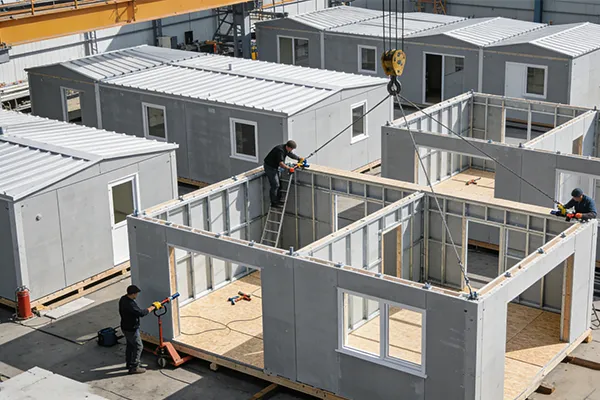
Compact packing should still protect steel surfaces, panels, glazing, doors, electrical parts and sanitary components. Specify moisture protection, corner protection, separation materials, fastening and package identification according to the route and storage plan.
Compared with shipping a fully assembled volumetric module, knock-down or folding formats can use container space differently but require more handling and assembly control at the destination. Include both advantages and added site responsibilities in the commercial evaluation.
Build a freight-ready RFQ in seven steps
- Select the exact container house model and drawing revision.
- Freeze quantity, layout and option packages.
- Obtain the preliminary packing list, weights and loading diagram.
- Provide origin, destination, site route and required delivery date.
- Request matched Incoterm quotations from the factory and logistics provider.
- Add destination charges, duties, inland delivery, unloading and storage.
- Revalidate the packing data after the production configuration is approved.
Do not book freight against an early sales layout if later options can change package dimensions or weight.
Foire aux questions
Is container house shipping cost included in the unit price?
Do not assume it is included. Check the Incoterm, named location and exclusions. Factory supply, ocean freight, duties, inland delivery and unloading may be separate.
Combien de maisons-conteneurs démontables peut-on charger dans un 40HQ ?
Sinomega lists 12 detachable units per 40HQ. Confirm the final configuration, packing and loading drawing before booking.
How many expandable houses fit in a 20ft container?
The website states three sets per 20ft container. Verify the exact expandable model, options, weights and packing arrangement for the order.
Can I calculate freight from the deployed house dimensions?
No. Use packed dimensions, gross weight, package count and loading plan. The deployed dimensions do not describe the shipping form.
Why is there no universal freight price?
Rates depend on route, date, container type, carrier, surcharges, handling, customs, inland transport and site access. A current route-specific quote is required.
Request a packing and shipping quotation
Compare the Maison conteneur détachable et Maison conteneur extensible packing references, then review the Maison en kit when a knock-down system is being considered. Use Sinomega's contact page to submit the model, quantity, destination, Incoterm, delivery window and site access information for a validated packing plan and quotation.